How Long Do Transits Last?
How long is a New Moon, Full Moon or Eclipse active? When are planetary stations in effect? Are all planets and aspects active for the same amount of time? Learn how long transits are typically in effect.
How Long Do Transits Last?
Well, it depends.....
New Moons
The New Moon begins a process of influence that lasts 29 days (until the next New Moon). The immediate energy of the New Moon can usually be felt up to 2-3 days before and after. In the days before a New Moon, people often report low energy, attributed to the letting-go nature of the final phase of the lunar cycle.
Full Moons
Full Moon energy can usually be felt for up to 2-3 days before and after.
For more information about New Moons and Full Moons, read my article about Sun-Moon cycles.
Eclipses
Solar Eclipses and Lunar Eclipses are actually New Moons and Full Moons, respectively, but have supercharged energy because they are so precisely aligned.
Most of the time, eclipses happen in pairs - Solar-Lunar or Lunar-Solar, each spaced about 2 weeks apart (just like New and Full Moons). The two weeks in between these eclipses often feel very intense – like two weeks of Full Moon energy! We get a set of eclipses about every 5½ months. That means there are 2 sets of eclipses each year – sometimes sort of 2½ if a set from the previous or following year overlaps at the turn of the year.
How long the effect of an eclipse lasts varies a lot depending on several factors—including which astrologer you ask! One view is that there can be added intensity during the 2-3 days before and after the eclipse, like a supercharged New or Full Moon but more powerful. Another view is that the longer the eclipse is in totality, the longer the effects will last—months or years after the eclipse itself.
One view of eclipses is that, similar to regular New and Full Moons, a Solar Eclipse releases energy will culminate at the Lunar Eclipse of the next set of eclipses (5-6 months later). In the same way, a Lunar Eclipse become a turning point for the previous Solar Eclipse's themes which play out over the next 5-6 months, up to the next Solar Eclipse.
The house and aspects the eclipse makes to your natal chart can indicate how you may be affected by the eclipse. It's a good idea to watch for these themes in your own life, especially those that last for months or even years, as they unfold from the eclipses, to see how sensitive you are to eclipse energy.
For more information, read about Solar Eclipses, Lunar Eclipses and eclipse times in our Glossary.
Planetary Stations and Retrogrades
Retrograde motion is when a planet appears to go backwards in the sky for a period of a few weeks to a few months, depending on the planet. Planets don't really go backwards; it is actually an optical illusion, when we view the planet from Earth's perspective, but it is considered very significant astrologically.
When a planet changes direction, it's called a "station" or "being stationary." When a planet changes direction, it goes retrograde (backwards) after being direct for a time, or it goes direct again (forwards) after its retrograde period. During a station, the planet appears to slow down, pause, and then resume its motion in the other direction. The whole process of changing direction takes place over a few days to a couple of weeks.
All planets (except the Sun and Moon) go retrograde some of the time. Mercury goes retrograde about 3 times per year (for about 3 weeks each). Venus only goes retrograde every 1.5 years (for about 6 weeks), and Mars goes retrograde every 2+ years (for about 2 months). All other planets go retrograde once a year (for about 4-5 months). The duration of retrograde periods is given in the column text.
When a planet stations, the astrological effects last for up to a week before and after. We may feel a general intensity, heaviness, pressure or scattered energy on a mental, emotional and/or physical level. It can also be a time when you experience a "turning point" in areas of life related to that planet.
For more information, read my article series about retrograde planets.
Planetary Aspects
(conjunction, opposition, square, trine, sextile, etc.)
Aspects from the Moon to any planet typically lasts only about a day, maybe two, since the Moon moves so quickly. It averages about half a sign per day, so it doesn't stay in orb (up to 8 or 10 degrees) for very long.
Aspects between only the Sun, Mercury and/or Venus can usually be felt for about 1-2 days before and after the event. If Mercury or Venus are within a week or so of making a station (turning retrograde or direct), the effect can be longer and stronger.
Transits from Mars to the other outer planets can often be felt for a week or more.
And transits between the outer planets (Jupiter, Saturn, Uranus, Neptune, Pluto, Chiron) have a lasting effect for weeks, months and sometimes years, although each aspect's energy will be most intense for about a week before and after it is exact.
For more information about the effects of different planetary energies and aspects, see my Glossary section.
Planet in Sign
The time range for a planet travelling through a sign varies greatly depending on the planet:
- The Moon takes about 2¼ days to go through a sign.
- The Sun moves through a sign about every 30 days.
- Mercury averages about a month per sign, but varies considerably from 2 to 10 weeks! The longer time range is when Mercury goes retrograde and spends extra time in the sign.
- Venus also averages about a month per sign, and varies from as little as 3½ weeks to over 4 months in a sign! As with Mercury, Venus spends more time in a sign when she goes retrograde.
- Mars averages about 8 weeks per sign, with as little as 5 weeks per sign, and as long as 7½ months when retrograde!
- Jupiter is pretty predictable, taking about a year to go through a sign.
- Saturn takes about 2½ years.
- Uranus about 7 years per sign.
- Neptune about 14 years per sign.
- Pluto varies considerably from around 11 years (Scorpio) to about 34 years (Taurus) per sign, due to its off-centre orbit.
- Chiron also varies greatly, from 2 to almost 9 years per sign, due to its off-centre orbit.
Support Evolving Door Astrology! Every donation helps to keep this site free for everyone. Thank you!
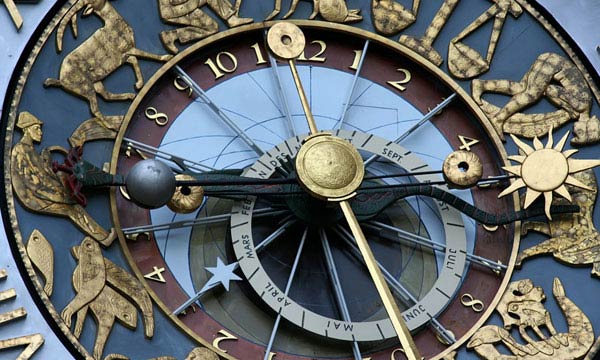
© 2005 Wendy Guy, All rights reserved. This content may not be copied or used without the expressed permission of the author. Image of astrological clock, Oslo, Norway.